What Is a 2-1 Buydown, and Can It Help San Antonio Buyers?
A 2-1 buydown is a prepaid arrangement that lowers your mortgage payment for the first two years, typically by 2 percentage points in year one and 1 point in year two, before the payment settles at the loan's full note rate in year three. The upfront cost is often paid by the seller or builder as a concession. With mortgage rates back above 7% this fall and San Antonio buyers holding more negotiating room than they have in years, it's a tool worth understanding before you write an offer.
Why buydowns are back in the conversation
Rates moved quickly this fall. Freddie Mac's Primary Mortgage Market Survey put the average 30-year fixed rate at 7.40% for the week of October 8, 2026, up from 7.28% the week before and 6.30% a year earlier. That followed the Federal Reserve's September 16 decision to raise its target range by a quarter point to 3.75%-4.00%, its first increase since 2023. (These are national survey averages, not an offer or a quote of TLP mortgage rates. Your rate depends on your credit, loan type, down payment, and the market on the day you lock.)
Here at home, the local market is giving buyers more time and more choice. According to the San Antonio Board of Realtors (SABOR), as reported by Texas Public Radio, August 2026 sales rose 4% year over year while the median price held just above $299,000. Inventory sat just under six months, and homes averaged about 82 days on market.
More inventory and longer market times often mean sellers are more open to concessions. Instead of only asking for a lower price, you can ask a seller to put money toward your financing.
How a 2-1 buydown works
With a 2-1 buydown, the seller, builder, or another eligible party deposits funds into an account at closing. Each month during the first two years, that account covers the gap between your reduced payment and your full payment.
Here's a hypothetical example on a $280,000 30-year fixed loan with an illustrative 7.25% note rate (principal and interest only; this is not a rate quote):
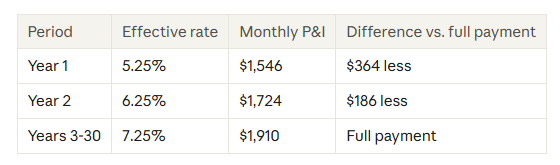
In this example, the buydown subsidy totals roughly $6,600, and that is the amount the seller or builder would need to fund. Taxes, insurance, and mortgage insurance would be added to these payments.
What a buydown doesn't change.
Your note rate. The loan is still written at the full rate. In year three, your payment rises to the full amount.
How you qualify. Under Fannie Mae guidelines, lenders qualify you at the note rate, not the reduced first-year rate. You need to be comfortable with the year-three payment from day one.
Program limits. Buydown funds from a seller or builder count toward each loan program's limit on seller or "interested party" contributions.
Seller concessions: what Texas buyers should know
Each loan program caps how much a seller can contribute. That limit is shared among closing costs, prepaids, and any buydown. In general terms:
Conventional: limits vary by down payment and occupancy under Fannie Mae and Freddie Mac rules.
FHA: seller contributions are generally capped at 6% of the sales price.
VA: VA caps seller concessions at 4% of the home’s reasonable value, but that’s not the whole story. Under VA rules, the seller can also pay the buyer’s normal closing costs and discount points, and those don’t count toward the 4%. That means total seller help on a VA loan can go beyond 4% when the offer is set up correctly. The details matter, and this is where an experienced VA lender earns their keep. Our team knows how to structure VA offers so veterans and their agents can make the most of every concession allowed.
Your loan officer and your agent should work together on the numbers before you write the offer. The goal is to make sure the concession you ask for actually fits your loan.
Buydown vs. price cut vs. permanent rate reduction
There's no single right answer. It depends on how long you plan to stay and what matters most to your budget.
2-1 buydown: Lowers payments in the first two years. This can help if you expect your income to grow or want breathing room while you settle in.
Price reduction: Lowers your loan amount and your payment for the life of the loan and may reduce your down payment. It can also help with the appraisal.
Discount points (permanent buydown): Reduces the note rate for the life of the loan. This can make more sense if you expect to keep the loan for many years.
Some buyers also plan to refinance if rates fall. That's a reasonable thing to watch for, but no one can promise rates will drop. Choose a payment you can handle at the full note rate.
A note for new-construction buyers
Builders around San Antonio frequently advertise rate incentives, and some are tied to the builder's affiliated lender. Those offers can be valuable. Still, compare the full picture: price, incentive amount, closing costs, and the loan estimate. As Freddie Mac's chief economist Sam Khater noted with the October 8 survey, shopping around and comparing multiple quotes can make a meaningful difference over the life of a loan.
Talk it through with a local team.
Rates above 7% don't have to stop your plans. They just call for a sharper strategy. At TLP Mortgage, we help San Antonio buyers, veterans, and their agents compare buydowns, price reductions, and loan programs side by side so you can make the call that fits your real life. That's what we mean by Mortgage Strategy Built for Real Life.
When you're ready, reach out to the TLP Mortgage team for a no-pressure conversation.
Rates and programs subject to change. Not a commitment to lend. Rates and statistics cited are from the sources and dates noted and are not an offer or a quote of TLP Mortgage rates. This article is for educational purposes and is not tax or legal advice.
Frequently asked questions
Who pays for a 2-1 buydown?
Usually the seller or builder pays as a concession, but lenders and, in some cases, family members or employers can fund one too. The funds are set aside at closing to cover the payment difference in years one and two.
Do I qualify for my mortgage at the lower buydown rate?
No. Under Fannie Mae guidelines, lenders qualify you at the full note rate. Plan your budget around the year-three payment.
Can I use a 2-1 buydown with an FHA or VA loan?
Temporary buydowns can be used with many FHA, VA and conventional loans. Seller-funded buydowns count toward each program's concession limit, so talk with your loan officer about how your offer will be structured.
Is a buydown better than asking for a lower price?
It depends on your plans. A buydown helps your early payments, while a price cut lowers your loan amount for the life of the loan. Comparing both with real numbers is the best way to decide.
Are buydowns common in San Antonio right now?
With SABOR reporting nearly six months of inventory and about 82 days on market in August 2026, many buyers have room to negotiate concessions, and local builders frequently advertise rate incentives. Every deal is different, so ask your agent what's realistic for the home you want.
TLP Mortgage Branch NMLS #2786297 DBA ©Pilgrim Mortgage® NMLS #225091 | Equal Housing Lender