Rate Buydowns in San Antonio
Rate Buydowns in San Antonio: How to Lower Your Mortgage Payment When Rates Top 7%
A rate buydown is money paid up front, by you, the seller, or sometimes a builder, to lower the interest rate on your mortgage, either for the first few years or for the life of the loan. With 30-year rates back above 7% this fall, a buydown can make a monthly payment easier to manage. And in today's San Antonio market, the seller may be willing to help pay for it.
Let's walk through how buydowns work, what they cost, and how to decide whether one fits your plans.
Why buydowns are back in the conversation
According to Freddie Mac's Primary Mortgage Market Survey, the average 30-year fixed rate was 7.28% for the week of October 1, 2026, up from 7.03% the week before and 6.34% a year earlier. The 15-year fixed averaged 6.60%. These are national averages published by Freddie Mac not an offer or a quote of TLP Mortgage's rates.
Locally, the picture is more balanced than it was a few years ago. The San Antonio Board of Realtors (SABOR) reported that August 2026 home sales rose 4% from a year earlier, the median price held just above $299,000, homes spent about 82 days on market, and supply sat just under six months. SABOR Chair Ed Zapata summed it up: "Buyers have time and choice, while sellers need to be thoughtful about pricing."
When homes take longer to sell, sellers are often more open to concessions. For many buyers, a seller-paid buydown can do more for the monthly budget than a small price cut.
The two main types of rate buydowns
Temporary buydowns (like a 2-1 buydown)
A temporary buydown lowers your rate for the first year or two, then it steps up to the full note rate. In a 2-1 buydown, the rate is 2 percentage points lower in year one and 1 point lower in year two. From year three on, you pay the full rate.
The difference in payments is usually funded up front and held in an account that covers the gap each month. It works well if you expect your income to grow, or you want breathing room while you settle into a new home.
One important detail: lenders generally qualify you at the full note rate, not the reduced year-one rate. A temporary buydown helps your cash flow; it doesn't usually stretch how much house you qualify for.
Permanent buydowns (discount points)
Discount points lower your rate for the life of the loan. One point typically costs 1% of the loan amount, and how much each point lowers the rate varies by lender, loan program, and market conditions. Points have become common: the Consumer Financial Protection Bureau reported in 2024 that the share of home-purchase borrowers paying discount points rose from 31% in 2021 to 61% by September 2023.
Points make the most sense when you plan to keep the loan long enough to recover the up-front cost through lower payments. That "break-even" timeline is something we can map out with you.
What a 2-1 buydown can look like: an example
Here's a simplified, hypothetical illustration, not a quote, rate offer,, or estimate of your costs. Say you're borrowing $284,000 on a 30-year fixed loan with an example note rate of 7.25%.
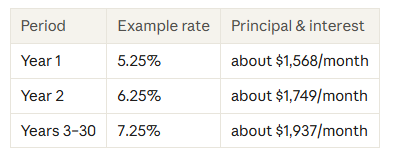
In this example, the buydown saves about $369 a month in year one and $188 a month in year two, roughly $6,700 in total. That's about what it would cost to fund it. Taxes, insurance, and mortgage insurance aren't included, and your actual numbers will depend on your rate, loan program, and lender.
Who pays for a buydown?
The seller. In a market like San Antonio's right now, asking the seller for a concession that funds a buydown is a common negotiation strategy. Your realtor and loan officer can help you decide what to ask for.
A builder. Many new-construction communities around San Antonio advertise rate incentives. Compare the full picture, price, rate, and closing costs, not just the headline rate.
You. You can pay for points yourself at closing if the long-term savings make sense.
Each loan program limits how much a seller or other interested party can contribute, and those limits vary by program, down payment, and occupancy. For VA loans, seller concessions are generally capped at “4% of the property's appraised value," though the seller paying the buyer's normal closing costs and discount points is treated differently from other concessions. Your loan officer can confirm the current limits for your specific loan.
Buydowns with Conventional, FHA, and VA loans
Buydowns can be used with many conventional, FHA, and VA loans, subject to each program's rules. For our veteran and military families, and San Antonio has a lot of you, a seller-funded buydown can pair with VA benefits such as no down payment for eligible borrowers. Program guidelines change, so it's worth reviewing your options with a loan officer before you write an offer.
Is a buydown right for you?
A buydown may be worth a look if:
You plan to stay in the home or keep the loan for several years (points).
You want lower payments while you settle in or expect your income to rise (temporary buydown).
The seller is open to concessions, and you'd rather lower your payment than the price.
It may be less helpful if you expect to sell or refinance soon, since you may not recover the cost of points. And no one can promise rates will fall later, so plan your budget around the full payment.
One more option to compare: sometimes a seller credit toward closing costs, or a small price reduction, fits your goals better. The right answer depends on your timeline and your budget. Please talk with a tax professional about whether points may be deductible in your situation; we can't offer tax advice.
FAQ
What is a 2-1 buydown? A 2-1 buydown lowers your mortgage rate by 2 percentage points in year one and 1 point in year two, then the rate returns to the full note rate for the rest of the loan. The cost is paid up front, often by the seller or builder.
Can the seller pay for my rate buydown in San Antonio? Often, yes. Sellers can contribute toward a buydown as a concession, within limits set by your loan program. In a balanced market like San Antonio's this fall, many sellers are open to negotiating.
Do I qualify at the lower buydown rate? Usually not. Lenders generally qualify you at the full note rate, so a temporary buydown improves early cash flow rather than increasing your buying power.
Are discount points better than a temporary buydown? It depends on how long you plan to keep the loan. Points lower your rate for the life of the loan but cost money up front; a temporary buydown gives short-term relief. Comparing break-even timelines with a loan officer helps you decide.
Can I use a buydown with a VA or FHA loan? Buydowns can be used with many VA, FHA, and conventional loans, subject to each program's guidelines and concession limits. Talk with a loan officer to confirm what's allowed for your loan.
Let's build your strategy together.
At TLP Mortgage, we believe in Mortgage Strategy Built for Real Life. Before you make an offer, have a call with you (and your realtor, if you like) to compare a buydown, points, seller credits, and different loan programs side by side so you can choose with confidence.
Rates and programs subject to change. Not a commitment to lend. All loans are subject to credit approval and underwriting guidelines.
©Pilgrim Mortgage® NMLS #225091 | DBA TLP Mortgage Branch NMLS #2786297 | Equal Housing Lender