If a seller or builder is willing to give a little, you usually have three ways to use it: a lower price, help with your closing costs, or a buydown that lowers your interest rate. The right pick comes down to two questions. How long do you expect to keep this home and loan? And is your tighter squeeze the monthly payment or the cash you need at closing?
With San Antonio inventory sitting around six months of supply this fall, many buyers have more room to ask than they did a few years ago (Texas Public Radio, reporting San Antonio Board of Realtors data, Oct. 16, 2026). Here is how to make that room count.
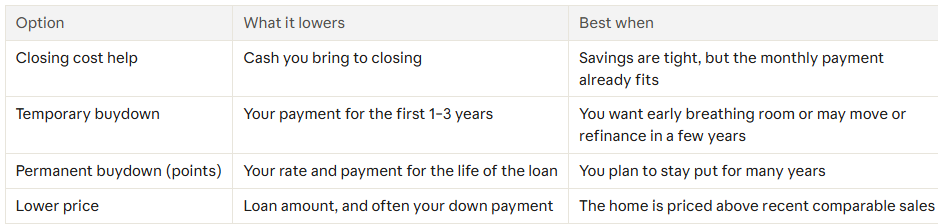
Your options at a glance
Option 1: Closing cost help
A seller credit can pay for customary closing costs, such as the appraisal, title charges and lender fees. That means less cash out of your pocket on closing day.
What it won't do is touch your monthly payment. So it works best when the payment already fits comfortably and the challenge is coming up with enough cash to close.
Option 2: A temporary buydown
A temporary buydown lowers your rate for the first one, two, or three years. After that, the rate goes back to the full note rate for the rest of the loan. Schedules are named for how much the rate drops each year:
1-0: 1 percentage point lower in year one
2-1: 2 points lower in year one, 1 point lower in year two
3-2-1: 3, 2 and 1 points lower in years one through three
The cost is paid upfront at closing and held in escrow. Each month, those funds cover the difference between your lower payment and the full payment.
Two things to plan for:
You qualify at the full rate. The lender looks at whether you can afford the payment after the buydown ends, not just the lower early payment.
The payment steps up. Budget around the full payment from day one, so the step-up never catches you off guard.
A temporary buydown is often a good fit if you might move or refinance within a few years, or if the first years in the home are when money is tightest: furniture, window coverings, the backyard fence. The savings land early and don't depend on keeping the loan for decades.
Option 3: A permanent buydown
With a permanent buydown, discount points are paid at closing in exchange for a lower rate for the full life of the loan. One point equals 1% of the loan amount. How much each point lowers the rate depends on the lender, the loan program and the market on the day you lock.
Because the lower rate lasts as long as the loan does, this fits best if you expect to stay in the home for many years. Permanent buydowns usually cost more than temporary ones for the same seller dollars, so they tend to work best with a motivated seller. If you might sell or refinance within a few years, you may not get the full value of what was paid.
Option 4: A lower purchase price
Don't overlook the simplest ask. A lower price reduces your loan amount, and since most down payments are a percentage of the price, it can shrink your down payment too.
A price reduction also doesn't count toward the seller-contribution limits below. One wrinkle: those limits are a percentage of the price, so a bigger price cut slightly lowers the dollar amount a seller can contribute on top of it.
Your real estate agent can pull recent sales in the neighborhood to show what sellers are actually accepting. If a home is listed above similar homes that just sold, the price is usually the place to start.
New construction note: Builders in San Antonio and the Hill Country often prefer incentives, like a rate buydown or closing cost credit, over cutting the base price. Ask exactly what each incentive is worth in dollars, and whether it depends on using a particular lender, so you can compare offers side by side.
How much can a seller contribute?
Each loan program caps seller and other interested-party contributions. These are the general limits as described by Lower (updated Nov. 19, 2026) and Fortune (Sept. 9, 2026). Your loan officer will confirm what applies to your loan:
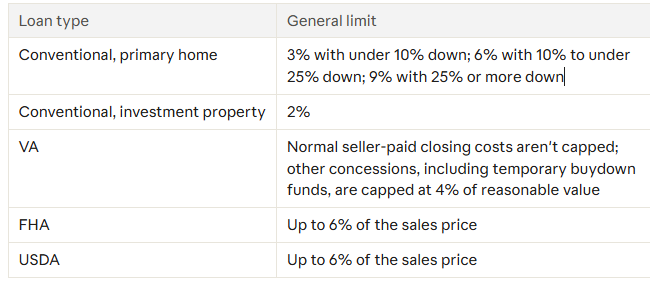
For example, on a $350,000 home with 5% down on a conventional loan, the 3% limit means a seller could contribute up to about $10,500.
A quick way to decide
Planning to stay many years? Look at a permanent buydown or a lower price.
Need breathing room early, or may move or refinance? Look at a temporary buydown.
Short on cash to close? Look at closing cost help.
Home priced above recent sales? Start with the price.
Many deals combine these. A modest price cut plus closing cost help, for example, is common.
FAQ
Is a seller-paid buydown better than a price reduction? It depends on your plans. A buydown targets your monthly payment, while a price cut lowers your loan amount and often your down payment. If the home is priced above recent sales, start with the price.
Can a seller pay my closing costs in Texas? Yes. Sellers can cover customary closing costs, within the limits of your loan program. Closing cost help lowers the cash you need at closing but doesn't change your monthly payment.
What's the difference between a temporary and a permanent buydown? A temporary buydown lowers your rate for the first one to three years, then it returns to the full rate. A permanent buydown uses discount points to lower the rate for the life of the loan.
Do I qualify at the lower buydown rate? With a temporary buydown, no. Lenders qualify you at the full note rate, so plan your budget around that payment.
How much can a seller contribute toward my costs? It depends on the loan. Conventional limits generally range from 3% to 9% for a primary home, depending on your down payment. FHA and USDA allow up to 6%, and VA caps most concessions at 4%, though normal closing costs aren't capped. Your loan officer will confirm what applies to you.
Let's run your numbers.
The right choice depends on your loan type, your rate, the price, and how long you plan to stay. Before you write an offer or answer a counteroffer, talk with the TLP Mortgage team. We'll lay out what each option could mean for your monthly payment and your cash to close on the specific home you're considering, so you and your agent can negotiate with confidence. That's Mortgage Strategy Built for real life.
Call 210-460-3778 No pressure, no obligation. mortgage strategy built
Temporary buydowns require a portion of the interest to be prepaid at closing and held in escrow. The cost may be paid by the lender, builder or seller. These funds cover part of the monthly payment during the buydown period. Not available on all programs, including most bond and reverse mortgage products. Other exclusions may apply.
This article is for educational purposes only and is not tax, legal or financial advice. All loans are subject to credit approval, underwriting, and program eligibility and availability. Rates and programs subject to change. Not a commitment to lend.
©Pilgrim Mortgage® NMLS #225091 | DBA TLP Mortgage Branch NMLS #2786297 | Equal Housing Lender