Debt Consolidation: HELOC vs. Cash-Out Refinance. Which Makes Sense for You?
If you're staring down a stack of credit card statements or a couple of high-interest personal loans, you're not alone, and you may be sitting on a solution you haven't fully considered: the equity in your home. Two of the most common ways homeowners tap that equity to consolidate debt are a Home Equity Line of Credit (HELOC) and a cash-out refinance. They can both get you to the same goal, lower interest, one simpler payment, and breathing room in your budget, but they get you there very differently.
THE PROBLEM WITH HIGH-INTEREST DEBT
Credit cards and personal loans often carry some of the highest interest rates a household will ever pay, and that interest compounds against you every month you carry a balance. Meanwhile, the equity in your home is typically financed at a much lower rate simply because it's secured debt. Moving high-interest, unsecured debt into a lower-rate, home-secured tool is the whole idea behind debt consolidation through your equity.
The tradeoff to understand up front: both a HELOC and a cash-out refinance use your home as collateral. That's what makes the lower rate possible, and it's also why the decision deserves a real conversation with your loan officer rather than a guess.
WHAT IS A HELOC?
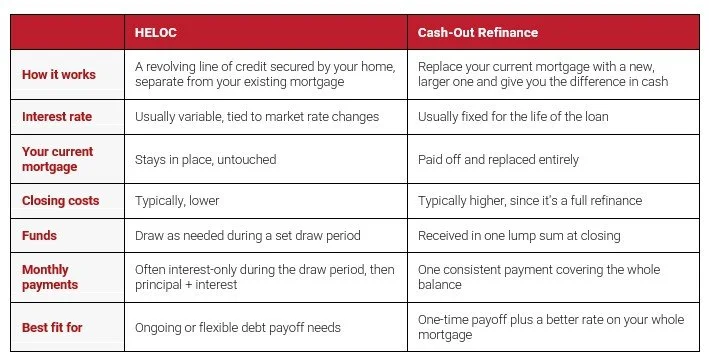
A HELOC is a revolving line of credit secured by your home equity, sitting separate from your existing mortgage. Think of it like a credit card with a much lower rate and a much bigger limit; you draw what you need, when you need it, during a set draw period, and you only pay interest on what you've actually used.
● Your current mortgage and its rate stay exactly as they are.
● Closing costs are typically lower than a full refinance.
● Great fit if you want flexibility, or if you're not consolidating all your debt at once
● Rates are usually variable, so payments can shift over time
WHAT IS A CASH-OUT REFINANCE?
A cash-out refinance replaces your current mortgage entirely with a new, larger loan. The difference between what you owed and your new loan amount comes to you as cash at closing, which you can then use to pay off those higher-interest balances in one shot.
● You end up with one loan and one monthly payment, period.
● Rates are typically fixed, so your payment is predictable.
● Makes the most sense if today's mortgage rates are at or below what you're currently paying
● Closing costs run higher since you're refinancing the full loan amount
SIDE BY SIDE
WHICH ONE ACTUALLY FITS YOU?
A few questions worth asking yourself before you decide:
● Do I want one lump sum to pay everything off at once, or flexibility to draw funds over time?
● Is my current mortgage rate better than today's market rates? (If so, a HELOC protects it. If not, a refinance could improve your whole loan.)
● Would I rather have a predictable fixed payment, or am I comfortable with a variable rate?
● How much am I trying to consolidate, and how soon do I want it resolved?
There's no universal right answer; a homeowner sitting on a great 3-4% mortgage rate is often better served by a HELOC that leaves that rate untouched. A homeowner whose current rate is higher than today's market may come out ahead with a cash-out refinance that improves the whole loan while also clearing the debt. This is exactly the kind of decision worth running through real numbers on, not guesswork.
NOT SURE WHICH ROUTE FITS YOUR DEBT?
Let's run your numbers side by side, no pressure, just clarity. Reach out to the TLP Mortgage team and we'll walk you through what a HELOC or cash-out refinance would actually look like for your situation.